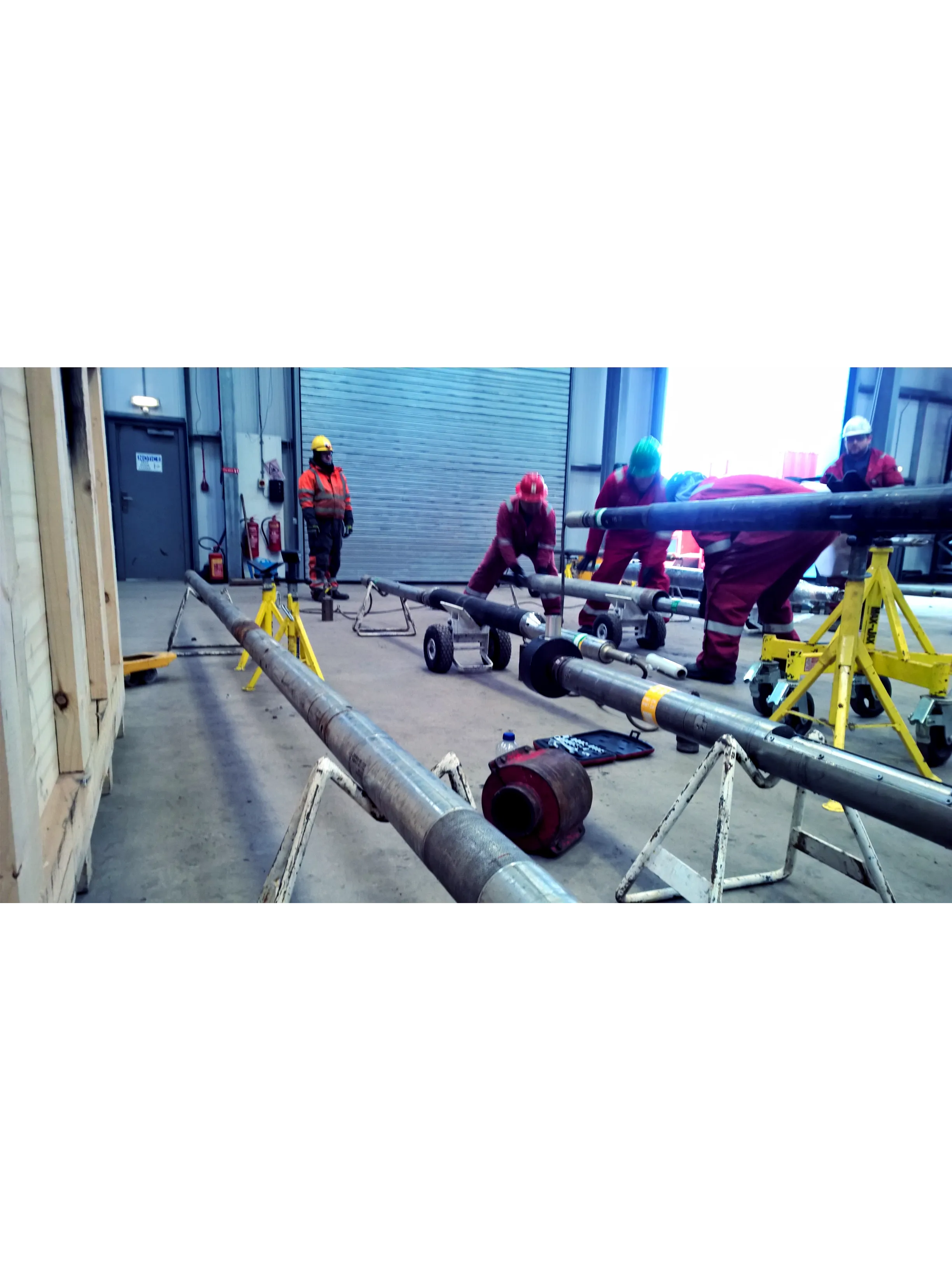
Wireline logging is one of those rig operations where several teams are involved at once, and the boundaries between drilling execution and subsurface objectives naturally start to overlap. In most cases the work gets done smoothly, but when conditions drift or priorities collide, it is not always obvious who is responsible for making the call in real time. This is where having clear roles and dedicated technical oversight can make the difference between a clean acquisition and a run that becomes a discussion weeks later.
Logging sits between drilling and subsurface
Most parts of a drilling campaign come with an established chain of responsibility. The drilling supervisor owns the wellbore and the safe conduct of operations, while the subsurface team defines what needs to be learned from the well. Wireline sits directly in the middle of those worlds.
The tools are physical, heavy, and deployed through drilling infrastructure, but the product is data that will influence reservoir understanding, development decisions, and future planning. That combination is exactly why logging tends to fall into a grey zone: it is not purely a drilling activity, and it is not purely a subsurface activity either.
When everything runs perfectly, that overlap is invisible. When it does not, it becomes very noticeable.
The common assumption that “someone is watching”
On most wells, a lot of experienced people are paying attention during logging. The service company crew monitors their equipment, the drilling team monitors borehole safety and conveyance, and the wellsite geologist monitors progress and communicates with the operations geologist.
The issue is not a lack of expertise on location. The issue is that logging supervision often becomes a shared responsibility without a single dedicated owner.
Each party sees part of the operation through their own lens. The contractor is focused on execution and tool performance. Drilling is focused on safe operations in the hole. Subsurface is focused on whether the acquired data will meet objectives. The wellsite geologist often becomes the bridge between them, while also managing many other tasks.
Most of the time this works, but the risk appears when small problems arise and nobody is clearly tasked with deciding whether they matter enough to act on.
Logging problems rarely look dramatic
When people think of logging failures, they often imagine obvious events: stuck tools, major breakdowns, or aborted runs. In reality, many costly problems are quieter.
A repeat pass that is not quite consistent. A depth alignment that looks acceptable until correlation begins later. Image quality that is technically delivered but not strong enough to support interpretation. Tension behaviour that suggests increasing risk, but not enough to force an immediate stop.
These are not headline failures, but they are exactly the issues that lead to uncertainty later, reprocessing debates, or additional runs that were not planned.
When logging is treated as something that will “probably be fine,” small compromises can accumulate until the final dataset no longer feels as robust as it should.
Service companies are not independent referees
Wireline contractors have strong internal quality processes and highly capable engineers, and operators depend on that. However, they are not independent arbiters of what is “good enough” for the operator’s subsurface decisions.
Their role is to deliver the contracted service efficiently and safely. Acceptance of marginal data, prioritisation of repeats, and decisions about where to spend additional rig time ultimately belong to the operator.
Expecting the service company to act as both contractor and referee places them in an impossible position. This is one of the reasons why independent oversight exists in the first place.
Where dedicated QC adds value
Independent wireline QA/QC at the wellsite is often misunderstood as mere witnessing. In reality, the value comes from something much more practical: full attention to the wireline operation, without competing responsibilities.
A dedicated QC specialist focuses entirely on whether execution is matching the acquisition plan, whether tool behaviour is stable, whether depth control and repeatability are within acceptable limits, and whether changes are being made consciously rather than by drift.
That specialist also provides the operations geologist with clear, timely information. Instead of hearing about issues after the job is finished, the operations geologist receives structured updates while decisions can still be made.
This is not about adding bureaucracy. It is about ensuring that the operator’s objectives remain central during execution.
The wellsite geologist cannot carry everything
In many wells, especially where budgets or logistics do not allow a dedicated QC presence, the wellsite geologist becomes the default point of contact for wireline.
Wellsite geologists are highly capable, but they are also managing lithology, tops, reporting, daily operations communication, and often a constant stream of requests from both the rig and the office. Adding full wireline supervision on top of this workload is not always realistic.
When that happens, the operation may still be completed successfully, but subtle technical issues are easier to miss, and the post-job reconstruction becomes harder.
This is not a criticism of the role. It is simply a reflection of bandwidth.
Paying twice usually happens after the job
The direct cost of wireline logging is obvious. The less visible cost appears later, when questions emerge about whether the data can truly be relied upon.
This may lead to re-runs, extended processing cycles, interpretive uncertainty, or disagreements over what was actually delivered and what should have been flagged earlier. Invoice reviews and failure investigations often highlight that the problem was not a single event, but a gradual loss of clarity during execution.
When logging quality is not owned clearly in real time, the operator is left managing the consequences after the fact, when the opportunity to correct course is gone.
Clear roles reduce friction, not increase it
Dedicated wireline QC does not remove authority from drilling or subsurface teams. Drilling remains responsible for safe operations in the wellbore. The operations geologist remains responsible for priorities and acceptance of results. The contractor remains responsible for providing the service.
Independent QC exists because none of those roles is designed to hold continuous, minute-by-minute responsibility for formation evaluation data quality at the rigsite.
Wireline logging sits at an intersection of disciplines, and that intersection works best when responsibilities are explicit rather than assumed.
Most wells do not suffer from a lack of competence or effort. They suffer from the natural complexity of having multiple teams involved, each doing their job well, but without a single person tasked solely with ensuring that the logging outcome remains defensible from first tool deployment to final deliverable.
That is where independent wireline QA/QC earns its place: not by taking control, but by keeping the operation aligned with the operator’s objectives while there is still time to act.