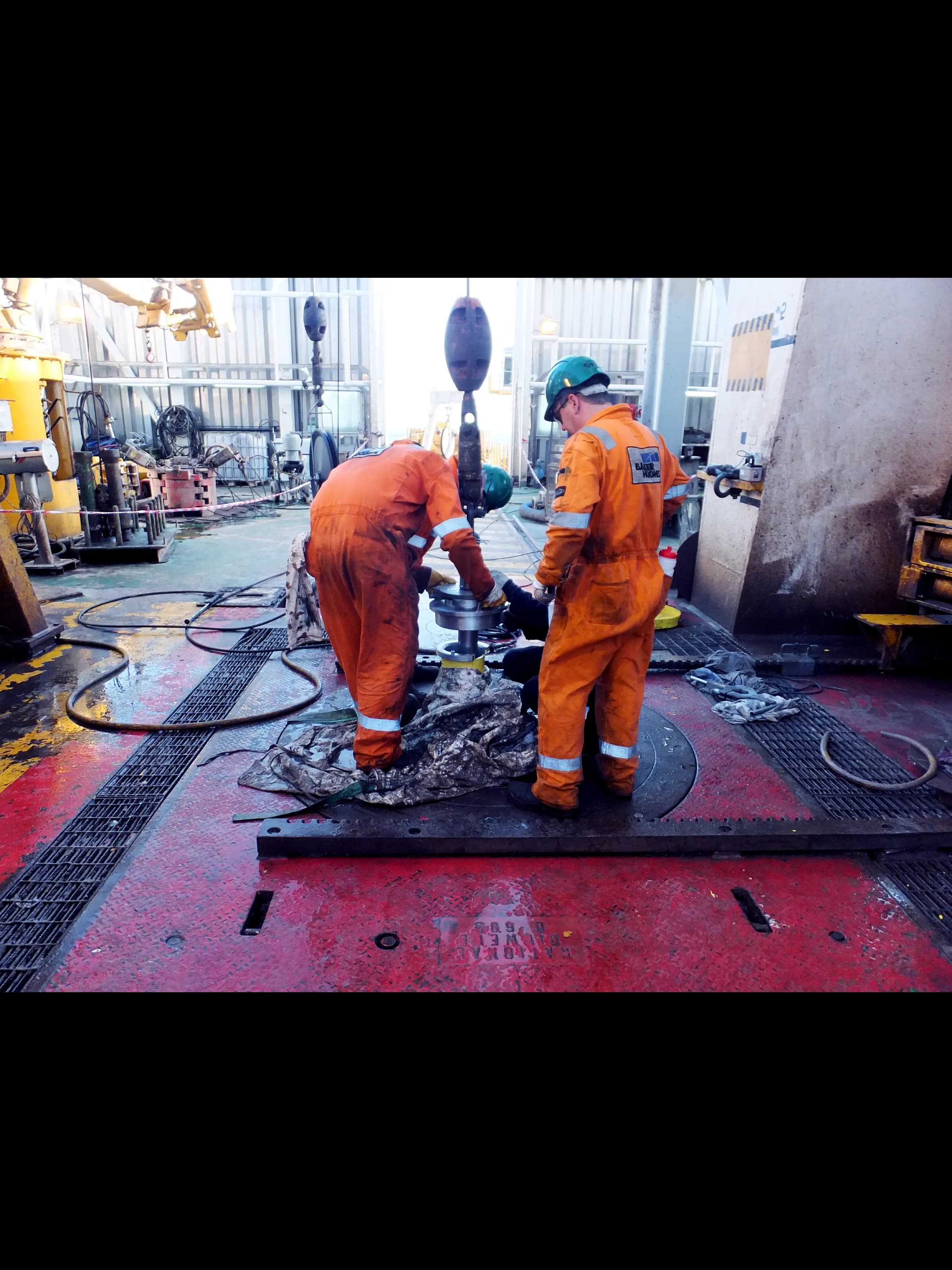
As a wireline consultant, I’ve seen that most incidents aren't caused by a lack of "luck." They are the result of failures in the pre-job planning phase. Here is a look at the critical failure points in wireline operations and how a proactive HSE strategy turns a "near-miss" into a non-event.
The Lethal Arc: Mechanical Failures and Spool Safety
It is a common misconception that the biggest danger in wireline is downhole. In reality, some of the most severe injuries occur right at the unit. According to IADC Safety Alert 00-10, a worker was tragically killed when he was crushed between the spokes of a wireline drum while attempting to guide the line. These incidents are rarely about a "malfunctioning" drum; they are about human-machine interface and the lack of mechanical safeguards. Early planning prevents these tragedies by:
- Specifying Units with Automated Spooling: Reducing the need for manual intervention near moving parts.
- Defining "Red Zones": Establishing strict exclusion zones around the drum and sheaves during high-tension operations.
- Equipment Verification: Ensuring all sheaves have a $D/d$ ratio (the diameter of the sheave divided by the diameter of the wire) of at least 40 to prevent wire fatigue and sudden parting.
Under the Gun: Explosives and RF Hazards
Perforating operations add a layer of chemical energy to the mechanical risks. IADC Alert 01-36 describes a surface detonation of a perforating gun that occurred while a crew was attempting to disarm it. When explosives are involved, the "invisible" environment—specifically Radio Frequency (RF) interference—becomes a silent killer. If you haven't performed a site-wide RF survey during the planning phase, you are gambling. Cell phones, digital radios, and even welding operations on the rig floor can inadvertently trigger a detonator. Preventing a surface detonation requires:
- Strict Lock-out/Tag-out (LOTO): Disabling all non-essential radio transmissions during gun arming.
- The "Five-Step" Rule: Ensuring guns are only armed when the tool string is at a safe depth, a protocol often bypassed when "rushing" to save rig time.
- Shielded Detonators: Specifying the use of RF-safe igniters as a technical barrier.
Maintaining the Barrier: Pressure Control Equipment (PCE)
When you're working on a live well, your lubricator and Blowout Preventer (BOP) are the only things keeping the reservoir in the hole. A failure here is almost always high-consequence. In one documented case (IADC Alert 03-14), a slickline lubricator failed under pressure because the union wasn't properly made up, leading to a high-potential release. True HSE excellence in wireline means treating the PCE stack as a critical barrier, not just "extra plumbing." Planning for pressure control involves:
- Compatibility Checks: Verifying that grease seal viscosity is matched to the expected wellhead pressure and ambient temperature. Cold weather can harden grease, causing a seal failure mid-operation.
- Function Testing: Not just "looking" at the BOPs, but performing a low-pressure and high-pressure test (typically to 1.1x the maximum expected surface pressure) before the tools ever cross the wellhead.
- Shear Verification: Confirming that the BOP rams are actually capable of shearing the specific wire or cable being used. If you're running heavy 7/32" e-line but your rams are dressed for 0.108" slickline, you don't have a barrier—you have a false sense of security.
The Strategy of Safety: The JSA is Not a "Tick-Box"
The most powerful tool in our HSE arsenal isn't a piece of hardware; it’s the Job Safety Analysis (JSA). Too often, the JSA is treated as a bureaucratic hurdle—a "tick-box" exercise performed while the crane is already lifting the lubricator. Real safety happens in the Office-to-Site planning meeting. This is where we identify "Simultaneous Operations" (SIMOPs). For example, if the wireline crew is rigging up while the rig crew is moving tubulars nearby, the risk of a dropped object hitting the wireline guide (a recorded cause of near-misses in IADC 03-06) increases exponentially. By identifying these conflicts 48 hours in advance, we can schedule tasks to ensure the wireline crew has the "floor" and the focus they need to work safely.